Natural enough for real callers
Fast turn-taking, interruptions, accents, context and multilingual journeys—designed around the way people actually speak.

Independent voice AI · Enterprise delivery
Voice agents that answer, qualify, resolve and act across your systems—with the controls your organisation needs and the ownership your team deserves.
From conversation to resolution
Enterprise Voice Agent combines natural real-time speech, organisational knowledge, system actions and tested guardrails. The result is a voice channel that can resolve work—not just answer questions.
Fast turn-taking, interruptions, accents, context and multilingual journeys—designed around the way people actually speak.
Read records, validate identity, book appointments, create cases, take payments through approved flows and update systems of record.
Rules, approvals, retention, audit trails and fallback are designed before launch.
Transcript, outcome and quality data reveal what to fix next.
Accounts, prompts, integrations, evaluations and runbooks transfer to you.
One workflow, end to end
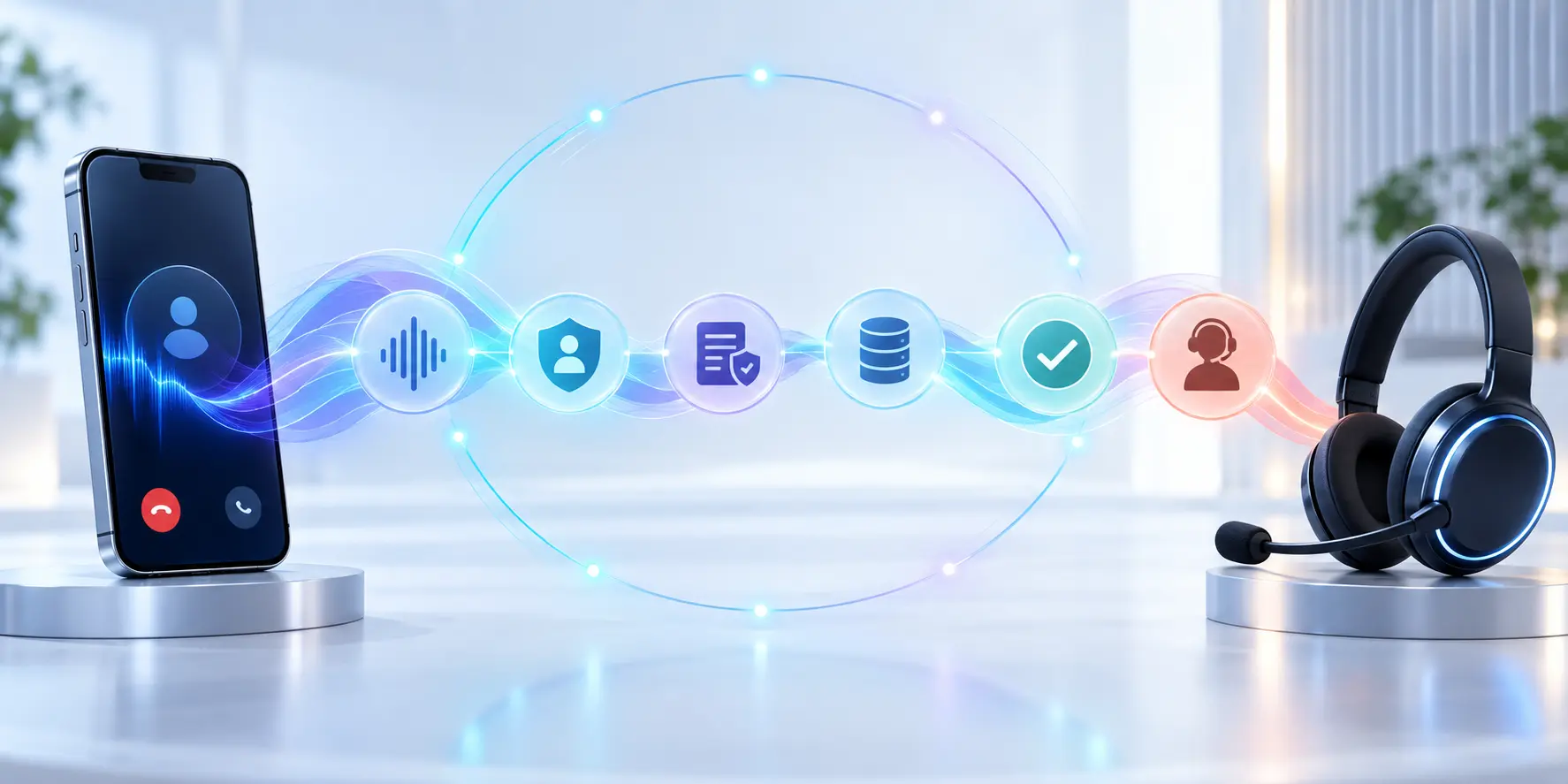
A reliable voice agent is a connected workflow with explicit boundaries—not a prompt attached to a phone number.
Inbound, outbound, overflow or after-hours.
Capture the need and verify the caller when required.
Use current policy and approved system tools.
Stop, transfer or seek approval at defined boundaries.
Log, score and improve against real conversations.
What enterprises need answered
Prospects should not have to wait for a sales call to understand the architecture, integration model, security posture or delivery path.
Select for latency, language, residency, quality and economics—not reseller margin.
Platform approach →SIP, APIs, events and approved automation connect the agent to your environment.
Integration landscape →Data flow, permissions, fallbacks, evaluations and evidence are designed into the service.
Security & governance →Ownership by design
We write the exit into the first statement of work. Stay because the relationship creates value—not because leaving is difficult.
Reference system
Connect channels, identity, orchestration, models, knowledge, tools, business systems, oversight and evidence as one production design.
Voice, web, email, collaboration tools, verified user and consent.
Enterprise ecosystem
Explore the operating layers behind a production agent.
Voice, web, messaging, email, collaboration tools and embedded experiences.
Measure before you automate
Map demand, delay, failure, rework, policy, data access and ownership before selecting a model, channel or vendor.
Why people call, when, from where and with what urgency.
Where callers repeat themselves, abandon, transfer or call back.
Which steps require judgement, data, action or approval.
Where truth lives and whether safe APIs exist.
Identity, consent, payments, vulnerability, regulation and reputation.
Who owns the journey, exceptions, measures and future change.
Operating model
Choose work where outcomes are measurable, system actions can be controlled and the human operating model is ready.
 01
Resolve enquiries, account requests and changes across voice and digital channels.
Agent platform 02
Explain policy, guide applications, collect information and route complex public needs.
Agent platform 03
Answer questions, prepare work and complete approved actions across internal systems.
Agent platform 04
Qualify demand, update CRM, prepare proposals and coordinate follow-up.
Agent platform 05
Triage invoices, investigate exceptions and move approved work through controls.
Agent platform 06
Classify issues, check entitlement, schedule work and keep records current.
Agent platform✓Customer service
✓Citizen services
✓Employee operations
✓Revenue operations
↗Challenge the brief
↗Bring the whole system together
↗Make trade-offs visible
↗Design the exceptions

What a specialist changes
We identify the decisions, queues, handoffs and system actions where an agent can create measurable value without hiding risk or weakening accountability.
Separate the stated solution from the underlying operational constraint.
Align business owners, frontline teams, architecture, security, data and change.
Show where speed, quality, cost, control and customer effort conflict.
Plan identity failures, missing data, outages, vulnerable customers and escalation.